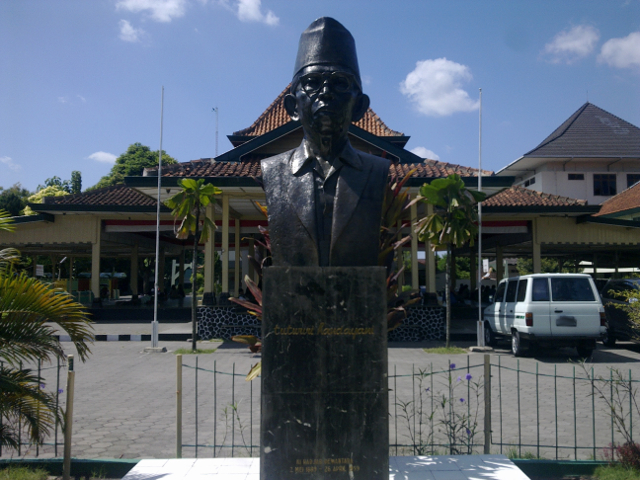
Ki Hajar Dewantara was born in the family of Kadipaten Pakualam, a small hereditary Duchy within the Sultanate of Yogyakarta, on May 2, 1889 in Pakualam, now is a region in the Special Region of Yogyakarta, with the name of Raden Mas Soewardi Soerjaningrat. Ki Hajar Dewantara, who is declared as The Father of Indonesian National Education, was the son of GPH Soerjaningrat and the grandson of Pakualam III.
After graduated from ELS (Eropheesche Lagere School), he continued his education to STOVIA, a doctor school for native, in Batavia - now Jakarta. Because of his illness, he was unable to finish his study in STOVIA.
Ki Hajar Dewantara worked as a writer and journalist for various famous newspapers at that time, such as: Kaoem Moeda, Midden Java, Poesara, Sedioutomo, De Expres, Oetoesan, and Tjahaja Timoer. He was a good writer, known for his sharp and communicative writings with anti-colonial spirit. He was active in social and politic organizations. Since Boedi Oetomo was founded in 1908, he was active in the propaganda division to socialize and increase people, particularly Javanese, awareness about the important of unity and integrity towards nation and state. He was also organized the first Boedi Oetomo congress in Yogyakarta.
Besides Boedi Oetomo, under the influence of Ernest Douwes Dekker, he also joined Insulinde, a multiethnic organization dominated by Indo who were fighting for their own government in Dutch East Indies. When Douwes Dekker founded the Indische Partij, Ki Hajar Dewantara also joined this organization.
There was a time when the Dutch East Indies government were collecting donation from citizens, including the natives, for the celebration of Netherlands Independence Day from French in 1913. This moment resulted in a critical reaction from nationalists, including Ki Hajar Dewantara. One of his most famous writing, “Als Ik een Nederlander was” or “If I were a Nederlander” was published in De Expres newspaper, owned by Douwes Dekker, on July 13, 1913. This article was considered poignant by Hindia Belanda officials. Some parts of the writing said “If I am a Dutchman, I would not celebrate an independence ceremony in the country where we ourselves, denied their rights of freedom. Consistent with the way of the mind, it was not only unfair, but also inappropriate to ask the Inlander (native Indonesian) to provide funds for such festivities. The very idea of the independence festivities alone is quite insulting for them, and now we also scour their pockets. Come on, away with the physical and spiritual humiliation! Had I am a Dutchman, a particular case that offends our friends and countrymen, is the fact that the inlanders required to participate and bankrolled an activity that do not have the slightest importance for them.”
Some Nederland officials doubted the originality of the writing, because the style was different from others Ki Hajar Dewantara’s works. They considered that Douwes Dekker had influenced him to write in such kind of style. As the result, under approval from Governor General Idenburg, Ki Hajar Dewantara was arrested. And under his own request, Ki Hajar Dewantara was exiled to Bangka Island. During that time, Douwes Dekker and Tjipto Mangunkoesoemo protested the arrest, which later the three of them were exiled to Nederland in 1913. These three figures were known as “Tiga Serangkai” or ‘Triumvirat”. Ki Hajar Dewantara was 24 years old.
Ki Hajar Dewantara was still active during his exile time; he was involved in Indonesian students organizations, Indische Vereeniging. During this time he was building his dream to improve native people’s life by learning about education until he received the Europeesche Akta, a prestigious certificate that will be his foundation in developing an education institution. During his study, Ki Hajar Dewantara was interested in ideas of some west education figures, such as Froebel and Montessori, as well as India’s education movement, Santiniketan by Tagore family. These influences were his foundation in developing his own education system.
After returning from his exile in 1919, Ki Hajar joined a school managed by his brother. His experience in teaching was useful to develop the teaching concept for his school that was established on July 3, 1922: Nation Onderwijs Instituut Tamansiswa or Perguruan Nasional Tamansiswa. The school’s motto in Javanese: “ing ngarsa sung tuladha, ing madya mangun karsa, tut wuri handayani” or "(for those) in front should set an example, (for those) in the middle should raise the spirit, and (for those) behind should give encouragement" is still famous in current Indonesian education society, and the last part of it, “tut wuri handayani” is adopted as the motto written in the logo of Indonesia Ministry of Education and Culture. When he was 40 years old, Raden Mas Soewardi Soerjaningrat changed his name to Ki Hajar Dewantara and no longer using his aristocracy title to be closer to all common people, body and soul.
In the first cabinet of the Republic of Indonesia, Ki Hajar was appointed as the first Ministry of Indonesian Education. In 1857 he received honorary doctorate title from Universitas Gadjah Mada for his merits in developing education. He was pronounced as the Father of National Education and his birthday become the National Education Day. Ki Hajar Dewantara passed away in Yogyakarta on April 26, 1959. He was buried in Taman Wijaya Brata.